
Search For A Review:
Reviews are in order by last name of author.
| A | B | C | D | E | F | G| H | I | J | K | L | M |
| N | O | P | Q | R | S | T | U | V | W | X | Y | Z |
| Books of the Year | About Me |
| ARC Reviews | Recent Posts |
| The Den (Home) |
MY ⭐️ RATING: 4.5/5
Format: Advanced Review Copy

BOOK DESCRIPTION
On the island of eternal grief
Even the gods have died a thousand deaths
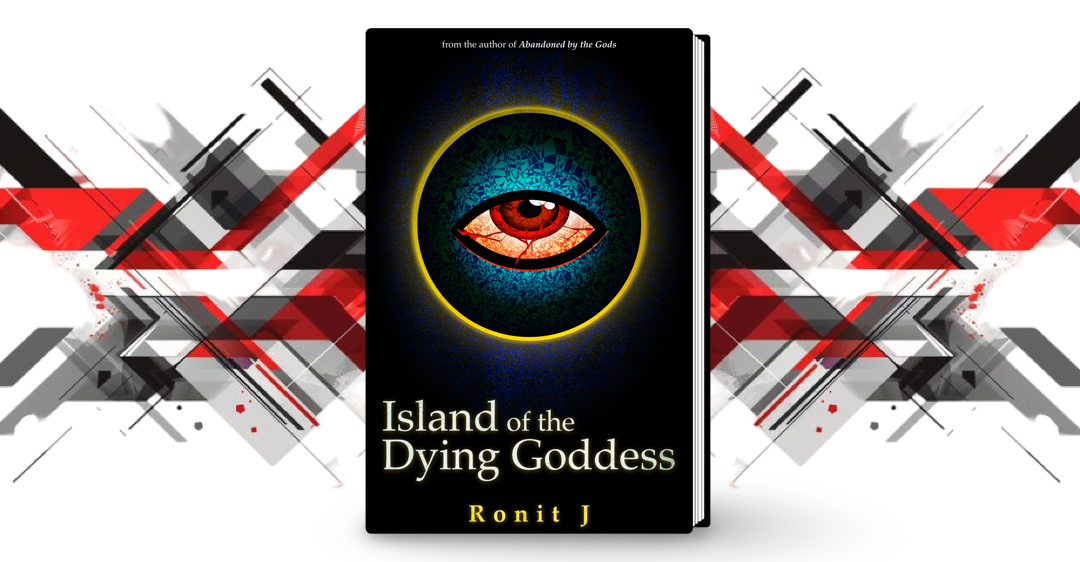
My name is Anawar, and I am an immortal explorer. A few days ago, I was stranded on Sawarrgh, an island where everything looks twisted and the air smells of mourning. The atmosphere has forced suppressed memories to resurface. I have to consciously keep them at bay, or I won’t be able to survive this island’s horrors.
There’s Ghaph, the mad warmongering god who mutilates his enemies and patches on their dismembered limbs. Then there’s Ndraja, the goddess who can enslave entire kingdoms with just her thoughts. But the worst is the nameless Goddess who created Sawarrgh a millennia ago, caging it in a barrier that reverses time, forcing the island to relive the same year over and over.
Sawarrgh is a nightmare come alive. Here, existence itself is a curse. The living are barely alive. The stranded, condemned.
I need to escape this island, and in doing so free Sawarrgh from its perpetual punishment.
And the only way to do that is to kill the Goddess.
🚨 I received an advanced reader copy, provided by the author for an honest review. 🚨
This did not impact my rating in any way.
MY REVIEW
I’m not sure this will suit everyone due to its edgier themes that may unsettle some, but Ronit crafts an incredible fusion of a dark, near-horrific storyline with a strong, character-driven narrative. He calls Island of a Dying Goddess a speculative exploration of grief and loss, and that rings true. This is a story that plummets you into a miasma of loneliness and despair, where hope feels like an impossible reach away. It reminds me of Luke Tarzian’s shadowy, metaphorical style, weaving meaning beyond the words, with Ronit’s grief flowing just as deep in his own way.
In the preface, Ronit bares his personal struggle with his father’s gradual decline from a stroke. This raw vulnerability bleeds into the pages of Island of a Dying Goddess, where Anawar, an immortal urja wielder and a clear stand-in of the author himself, wrestles with his father’s death. From this turmoil, the author weaves a story both strange and beautiful, the strangeness in its twisted metaphors and the beauty in its hidden truths.
This is pitched as Elden Ring meets A Fistful of Dollars, and it delivers that promise perfectly. Sawarrgh channels Elden Ring’s shattered desolation, a cursed island of eternal grief where time loops annually in a cruel reset, its jagged ruins and grotesque gods locked in a brutal, endless clash. Yet it carries the gritty bite of A Fistful of Dollars, with weary souls scraping by, pitting gods against each other in a desperate bid to break free and back to their original mission.
“Sometimes things don’t need to have meaning. Like death. When your loved one dies, you don’t need it to mean something, do you? You cherish the good, pat yourself on the back for surviving the storm, and then move on.”
Reading this dark tale, I found myself drawn into a quiet solace, piecing together the story like a puzzle begging to be solved, where deeper meanings ripple through the inhabitants of the cursed island. The twisted gods mirror strokes devastation: Ghaph an echo of body’s ruin and Ndraja, a theft of mental clarity. Humda, the hermaphrodite goddess, seems to stand for Ronit’s family as a whole, not just a single person, while The Nameless Goddess feels like his father, and Sawarrgh itself his fractured mind, and Kalma, the embodiment of death itself.
Anawar and Amos shine as mirrors of each other, though Anawar is a man, Amos is a humanoid-crustacean known as a reptonide. Anawar shoulders the crushing weight of grief, while Amos embodies the brighter side that may have been lost. Both play a vital role in the story though they are split a majority of the book as two halves of one soul navigate the same hellscape of horrors as they seek to break the island’s curse. One deals with it through grit while the other flashes the liveliness of witty, sarcastic quips that infuse scenes with some reckless fun.
I found myself contemplative after finishing this book. Ronit lays his soul bare with incredible skill, the grief raw and piercing. A decision he wrestles with struck me hard, one I might deal with someday, and I’m unsure of what I’d do. The message within is beautiful, hitting right where it needed to. This is a great work of speculative fantasy that closes on a bittersweet note as they set sail into the sunset, a quiet farewell to his father.

 Wolfmantula.com