
Search For A Review:
Reviews are in order by last name of author.
| A | B | C | D | E | F | G| H | I | J | K | L | M |
| N | O | P | Q | R | S | T | U | V | W | X | Y | Z |
| Books of the Year | About Me |
| ARC Reviews | Recent Posts |
| The Den (Home) |
MY ⭐️ RATING: 4.5/5
Format: Kindle Whispersync

BOOK DESCRIPTION
At the heart of every legend lies a truth.
Twisted and reshaped by the currents of time.
For twenty years, strategos Dexios has led the phalanx of Thena against its enemies, pulled from one battleground to another in a relentless cycle of war and bloodshed. Now, finally, he has found the courage to leave that life behind. To relinquish his officer’s sword and return to the verdant slopes of his vineyard with his wife and son.
Peace, however, is fragile and capricious. When Thena’s northern allies bring word of an enormous tauran horde gathering on their borders, Dexios has no choice but to answer the call to arms one last time.
As humans and tauros collide, another evil wakes. Whispered rumours of a clawed creature that stalks the shadowy streets. Of violent murders committed in the name of deities long thought vanquished. To speak their names is heresy.
They are the Exiled. The Banished.
The Ruined Gods.
MY REVIEW
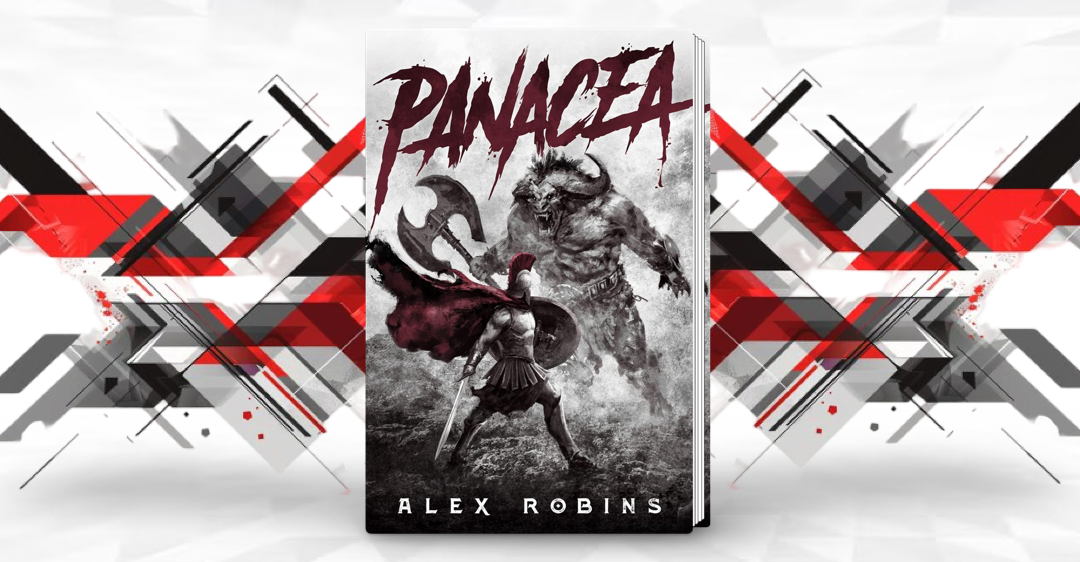
Do you know what hooks me instantly? A cover that screams “READ ME RIGHT NOW,” and of course it’s a Felix Ortiz cover, who always knocks it into another dimension. But do you know what I love more than a gorgeous cover? Historical fantasy, because it combines my two favorites, fantasy and history! And do you know what sends me to the Elysian Fields? GREEK historical fantasy.
Panacea lived up to everything I had hoped it would be. Robins plunges into a vivid authentic Bronze-Age inspired culture that sent me straight to Greece, as if I was marching along with all the characters in the phalanx. I could smell the aroma of wine, taste the decadent olives, and smell the sharp, metallic tang of blood on the battlefield. It’s immersive in the best way.
This is a fast-paced, twisted clash of gods and monsters told with an easily readable prose. While this does give the classic meddling gods trope, Robins flips the pantheon on its head in a very stylish way by the goddess’s ruling, overthrowing the male pantheon “ruined gods” in a similar way that Zeus himself, overthrew his own father, the Titan Cronus. Meanwhile, the city-state of Thena faces annihilation from a massive invading horde of tauros (roided-Minotaurs), while a divine war is beginning to brew.
“War is not a game. It is a penance. A price to pay for failure. The last possible solution when there are no other options. Do not wish for it. Do not strive for it. Victory is ephemeral. Death is eternal.”
Robins himself called Panacea, “Clash of the Titans meets 300 with a heavy dose of Greek mythology,” and he was not exaggerating, that is the perfect description. The blending of mythical gods, monsters and a heroic quest along with a grim military realism that absolutely hits with the battle that scenes. The shield-wall was incredibly written and such a tense and vivid moment, you could feel the fear radiating off the soldiers in that moment. I also read that he mentioned the Ray Harryhausen film, Jason and the Argonauts as another inspiration for the story. Now I’ll be honest here and say that I have seen this movie, though it’s been a very long time and it’s not on Prime, Netflix or Hulu, so I couldn’t rewatch it to see the inspiration. I do know the tragic story itself, just not the adaptation, near as well, so I can see some of the parallels.
The story rotates between three third-person limited POV’s, and Robins does a great job of bringing them to life. First, there’s Dexios, the grizzled veteran strategos, who is haunted by decades of war and suffering a bit from PTSD (which reminds me a lot of Auric, from Mike Shel’s Iconoclasts trilogy.) Then there is Keres, the son of Dexios, who’s young and eager to build his own legacy with glory and fame as a warrior. And finally, Helena, a scholar who is investigating a string of murders within the city walls. Her first chapter was a bit boring and I was worried I wouldn’t like her, but I was wrong and I liked her more, as the story progressed.
Jay Forrester’s narration was top-notch for the most part, he really got into the scenes and you could hear it in his voice, from the guttural screams of war to the roars of the Tauros, he plunged deep into the story and into every single character. But… I wasn’t a big fan of Forrester’s narrative voice, but it did grow on me the longer the story went on, it sounds a bit like that wise old character you run into on a mission, a bit condescending in a way. It’s hard to describe, it wasn’t terrible, but it wasn’t something I wanted to hear as much as it’s used.
Bottom line is, if you are a fan of historical fantasy, Greek mythology, meddling gods, brutal war, and great character work, I highly suggest giving Panacea and The Ruined Gods trilogy a shot! Especially now that it has narration to go with it… unfortunately, at the time of this review, only Panacea has an audiobook, but the others are coming!

 Wolfmantula.com